Hard Disk Check Tool For Mac
- OS X’s Disk Utility—which enables you to format, partition, repair, and perform other kinds of maintenance on disks (including SSDs, flash drives, and disk images)—is good for what it does.
- Apr 07, 2011 Disk Speed Test is an easy to use tool to quickly measure and certify your disk performance for working with high quality video! Simply click the start button and Disk Speed Test will write test your disk using large blocks of data, and then display the result.
- A list of free hard drive testing software programs. These hard drive test programs will do just that: test your hard drive for problems. As well as the ability to run a short and extended disk test. A Full Review of Bart's Stuff Test, a Free Hard Drive Testing Tool. A Full Review of Seagate SeaTools, a Free Hard Drive Testing Tool.
- For Hard Drive Speeds: BlackMagic Disk Speed Test Measuring the speed of your hard drive is the easiest benchmarking process around, and the best tool I’ve found for that task is the BlackMagic.
- If you cannot determine which files are open on the disk that you want to verify or repair, restart your computer and then mount the disk again, or start up from your Mac OS X Install DVD or CD to repair.
When your hard drive starts to fail, Disk Utility offers some useful disk repair tools. But if they don’t get it done for you, you might want to turn to one of the big guns: fsck. fsck, which stands for “File System Consistency Check,” is a command-line tool that reviews and repairs the underlying structure of a hard drive. And while we all hope we never have to use it, here’s a brief introduction into its functionality.
Note: the fsck tool in Mac is the same as the one found in Linux. This article is written with a focus on Mac’s user interface.
Finding the Right Disk
Before you can run fsck, you’ll need to find the device node and identifier of the disk you want to target. We’ll use Terminal’s diskutil command to accomplish that.
1. Open Terminal (/Applications/Utilities/Terminal.app)
2. Type the following command, then press “Enter.”
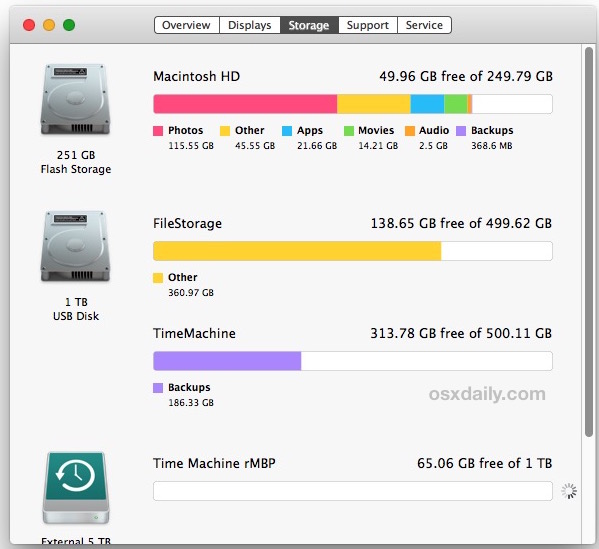
Apple has always provided a simple way to visualize used disk space under the Apple > About This Mac > Storage tab. While limited, it splits your usage up by Documents, Apps, Photos, Mail, and so on. While limited, it splits your usage up by Documents, Apps, Photos, Mail, and so on.
3. This will produce a list of all the currently connect drives, both mounted and unmounted.
Mac Disk Format Types
4. Locate the disk you want to run fsck on and find its device identifier. It will look like /dev/disk1, and you’ll find this information along the left margin of the Terminal window. Write this information down somewhere since you’ll need it in the next steps.

Running fsck from Single User Mode
fsck is a powerful utility, but macOS won’t let you run it from inside the operating system. You might think you can run fsck on a non-booting disk, but you’d be wrong: fsck is basically non-functional while in macOS’s userland. You’ll need to reboot into Single User mode, which is a stripped-down, text-only, superuser interface for macOS.
1. Restart your computer.
2. Hold down “Command + S” while your computer restarts. You can release the keys once you see white text start to appear on the startup screen.
3. Some white text will scroll by quickly. When it stops, you’ll see a command prompt at the bottom of the screen that says root#.
Hard Disk Diagnostic
If the text stops scrolling but you don’t see this prompt, press the “Enter” key once to reveal it.
4. To repair the boot disk, type in the following command, then press “Enter.”
This runs fsck with the -f flag which forces it to check journaled file systems like HFS+, as well as the -y flag, which automatically says “yes” to any prompts that fsck might encounter. Keep in mind that the -y flag can be a little dangerous: as the fsck’s man page points out, “this should be used with great caution, as this is a free license to continue after essentially unlimited trouble has been encountered.”
5. You can also use fsck to repair non-boot disks, but you’ll need to know the filesystem type. For example, if I wanted to run fsck on “/dev/disk2.” I might use the following command:
That command will run the HFS sub-version of fsck on that drive. Other available filesystems include fsck_msdos, which runs on FAT file systems; fsck_exfat, which examines ExFAT filesystems; and fsck_udf, which looks at UDF file systems.
4. fsck will check the file system and attempt to repair any damage that it finds. If it finds no damage, it will exit with “OK.”
Hard Disk Check Tool Mac
5. When fsck is finished checking and repairing the filesystem, type reboot into the command prompt and press “Enter.”
Conclusion
Itool For Mac
fsck on the Mac isn’t as powerful as fsck on Linux, but it can still be a lifesaver if you end up with a corrupted boot disk or damaged hard drive.